


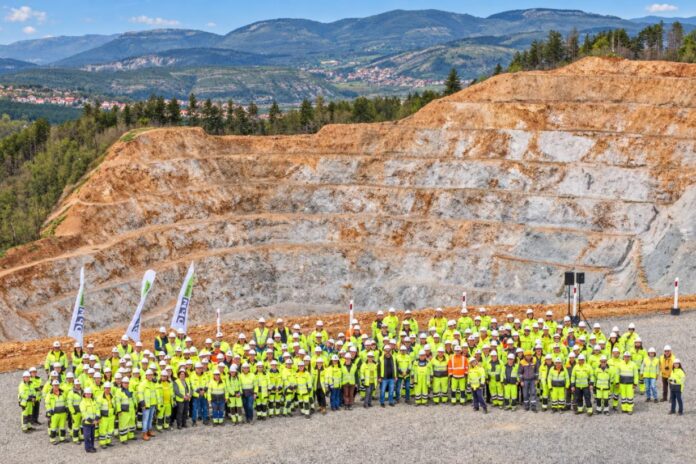
The closure of the mine near Krumovgrad does not mean the end of the mining industry in the Eastern Rhodopes. The region has promising areas, trained specialists and accumulated practical experience. The big question is whether Bulgaria will be able to turn this capital into new responsible investments - with clear rules, strict control and real benefits for local communities.
Mining at the Ada Tepe mine ended in July 2026 G. after the economically recoverable reserves are exhausted. This was a pre-planned end of the production cycle, and not a sudden cessation of business. Dismantling of the facilities follows, technical shutdown, reclamation and continuous environmental monitoring.
With the end of mining, however, a much more important conversation opens up: what will the region inherit from "Ada Tepe" and can other municipalities in the Eastern Rhodopes get the opportunity for similar industrial development?
The answer depends not only on the availability of gold and other metals. Systematic geological surveys are required, economically viable resources, predictable procedures, access to infrastructure and projects, capable of meeting modern environmental requirements.
The end of a mine should not be the end of regional development
The Eastern Rhodopes are among the regions of Bulgaria, in which demographic decline, aging and limited opportunities for well-paid work are felt particularly hard.
In such an economic environment, a well-managed industrial project matters, which exceeds the number of jobs in the enterprise itself. It creates a demand for transportation, construction, repair, security and engineering services, increases the need for vocational education and leaves more income in the local economy.
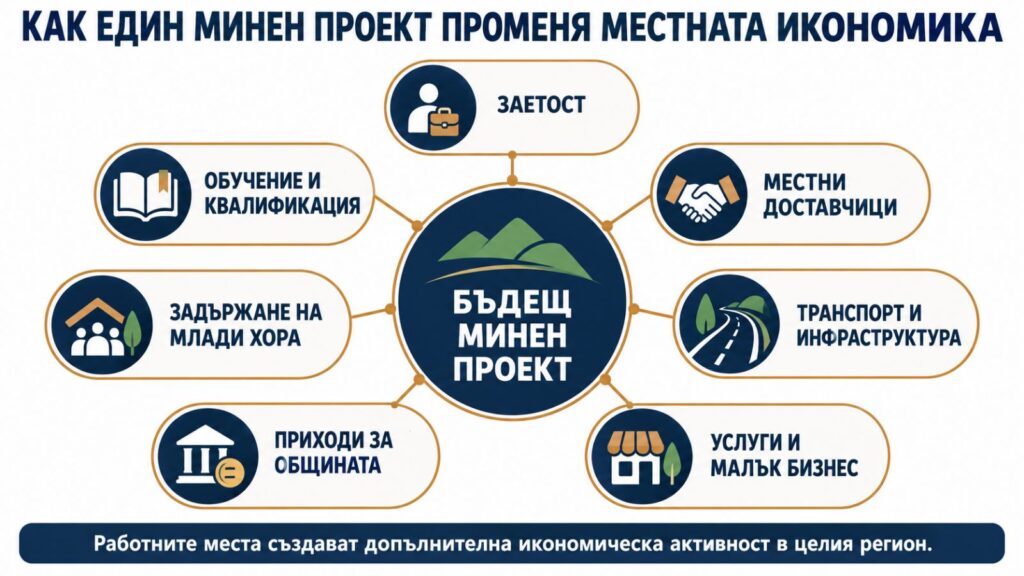
The experience of Krumovgrad shows, that the mine can also be a catalyst for non-mining activities. The fund created jointly by the company and the municipality has supported dozens of small businesses. According to the published results by the end of 2025 G. are assisted 89 the project and are created 173 non-mining jobs.
This model does not mean, that one mine can solve all demographic problems on its own. It shows something more practical: the big investment can give a small municipality time, infrastructure, skilled people and capital, on which to build other local enterprises.
The most valuable asset after Ada Tepe is people
After the end of mining in "Ada Tepe" the most valuable resource, which remains in the Eastern Rhodopes, are the trained professionals with practical experience in the modern mining industry. At the same time, the investor in the "Rozino" project has made a firm commitment that when hiring employees, priority should be given to the residents of the municipality of Ivaylovgrad. For applicants without the necessary initial training, qualification and requalification courses are provided, so that both the unemployed get a job opportunity, so are people, who want to change their profession. The goal is that the maximum part of the employment created and the income from the project remain in the municipality.
This local priority can naturally be supplemented by experience, piled up in "Ada Tepe". They worked in the mine and the beneficiation factory 269 souls, and more than 150 have undergone or participated in training and professional development programs. Among them there are operators, mechanics, electricians, engineers, geolozi, environmentalists and safety specialists, who already know the requirements of modern mining production.
Attracting some of these trained personnel in future projects in the Eastern Rhodopes will not displace local candidates. On the contrary, experienced specialists can help train new employees, building a production culture and applying high standards of safety and environmental control.
Rosino is the most advanced option
Among the famous projects in the Eastern Rhodopes, Rosino is the closest to a potential investment solution. The project is located near the villages of Rozino and Gugutka in the municipality of Ivaylovgrad and envisages open mining and flotation processing of gold and silver ores.
In March 2026 G. The Ministry of Environment and Water provided public access to the environmental impact assessment report. Due to the proximity to Greece, the materials also go through a cross-border procedure, as the Ministry of Education and Culture publishes documents, comments and answers in Bulgarian, English and Greek language.
This is an important clarification: Rosino is an advanced project, but not yet a working mine. All applicable procedures and conditions are to be met, before construction or mining can begin.
According to the investor, only in the first years of construction, more than 250 million. euro. Construction activities are expected to create more than 1000 jobs, and after the start of operation to be provided over 250 permanent positions. The company also states, that the technological scheme does not foresee the use of cyanides and is designed with a closed water cycle without discharge of production waters. These are significant project commitments, which must be checked through the permits, control and actual monitoring, if the project is implemented. Details of the concept are posted on the project page.
For the municipality of Ivaylovgrad, "Rozino" could be more than just a new employer, and an opportunity to create a local chain of suppliers, training of young people and return of some of the specialists, who today are looking for work elsewhere.
What other projects are there in the Eastern Rhodopes
The geological potential of the region does not end with "Rosino". Publicly known projects and prospective areas are at different stages and should not be put under a common denominator.
"Ordinary"
"Obicnik" is a gold project in the Momchilgrad area with an estimated inferred mineral resource and potential for further exploration. Geological studies connect it to the Zvezdel-Pcheloyadsko ore field and to epithermal mineralization, developed in volcanic and volcanogenic-sedimentary rocks.
The availability of a mineral resource is an important step, but not yet proof of an economically viable mine. Additional drilling is required, metallurgical tests, engineering assessments and permitting procedures.
"Macedonians" and area "Dъngovo"
Macedonians is a near-surface gold project, for which historical mineral resource estimates are known. The neighboring area "Dangovo" is considered as an opportunity to expand the exploration potential.
The term "historic mineral resource" is substantive: he means, that the data should not automatically be assumed to be an up-to-date stock, on which a mine can be directly projected. Up-to-date validation to applicable standards is required.
"Primrose"
Iglika is an early-stage copper-gold exploration project. The geological surveys are for several types of mineralization — skarn, epithermal and porphyry. This makes it geologically interesting, but also significantly more uncertain than a project with an estimated mineral resource and a completed engineering assessment.
The current analytical review places "Rosino", "Ordinary", "Macedonians" and "Iglika" at various stages — from early exploration to advanced design and permitting.
Prospect area is not a deposit, and the location is not automatic mine
This difference is fundamental to the honest conversation about mining. As geologist Petko Petrov explains in the BNR program "Hear the Summer":
“Until it becomes a deposit, protected in the ministry, it's all just predictions.”
Geological survey finds out what is underground, in what quantity, with what content and under what conditions. It does not automatically grant mining rights. Between the first geological anomaly and a working mine are boreholes, laboratory analyses, resource models, stock valuations, technological trials, preliminary and final studies, EIA, permits and investment decision. The process often takes 10–15 years.
For this reason, stopping geological exploration is not a form of nature protection. It is a refusal for the state to know what minerals it has. Only after collecting sufficient data can it be judged whether a project is economically justified and environmentally acceptable.
Geotopia discusses this sequence in detail in the materials "The road from rock to metal" And "The path of ore — from deposit to metal". For the need for up-to-date information and new studies, read the interview "Without new geological surveys, Bulgaria will miss its chance for critical raw materials".
What 'Ada Tepe' Really Proved
Before the mine was built, public concerns were serious. Some of them were valid questions, to which the investor and the institutions were obliged to respond. Others presented almost certain scenarios of environmental catastrophe: large-scale pollution, destruction of nature and irreversible damage to Krumovgrad.
The catastrophic predictions definitely did not come true. That doesn't mean, that mining is a zero-impact activity — each mine changes the terrain and must be subject to strict control. The more important takeaway is, that impacts can be limited by appropriate design, modern technologies, constant monitoring and pre-planned reclamation.
Prez 2025 G. delegation of the Ministry of Energy, Mining and Mineral Resources of North Macedonia pointed to "Ada Tepe" as an example of modern and responsible mining. The official announcement notes the water and waste management solutions used and the lack of a reported incident, endangered the environment during operation.
The project for the relocation and monitoring of protected land turtles has also been positively evaluated by the herpetologist and conservation expert Deyan Dukhalov. According to him, the case shows, that industry and conservation can and should work together.
After the closing is predicted 95% of the area, used by the mine, to be returned to the Natura 2000 ecological network.
How the model can be transferred to other municipalities
The Eastern Rhodopes do not need unconditional approval for every proposed mine. They need a working model, where good projects get a chance to be developed, and weak ones are dropped based on data and clear criteria.
Such a model should include:
- up-to-date geological research and available information on the mineral-resource potential;
- foreseeable deadlines for administrative procedures, without loosing control;
- independent water monitoring, the air, soils and biodiversity;
- financially secured reclamation even before the start of mining;
- priority training and hiring of people from the region;
- support for local suppliers and small businesses outside the mining sector;
- public tracking of concession payments and local investment;
- open dialogue with residents already during the survey, and not until after the project is drawn up.
This is a more reasonable position than the two extremes—conviction, that every mine necessarily brings prosperity, and the statement, that any mining intention inevitably leads to environmental disaster.
Geotopia opinion
The closing of "Ada Tepe" should not become the closing of accumulated knowledge, professional skills and economic energy in the Eastern Rhodopes. The region needs new investments, and geological surveys are the first necessary step, to identify which prospects can actually be turned into sustainable projects.
"Rozino" deserves to be evaluated according to the technical solutions presented, the evidence and conditions of the environmental procedure — not through automatic approval, but not by prior rejection. Same goes for Lover, "Macedonians", "Primrose" and any future area: geological explorations should be encouraged, and the mining permit — earned with a convincing project and measurable commitments.
"Hell beats" showed, that modern mining can work alongside the local community and under a strict environmental regime, without the catastrophic scenarios coming true, with which the people were frightened. The next task is to build on this experience — with even greater transparency, stronger independent control and a clear guarantee, that wealth underground will create long-term value above it.