


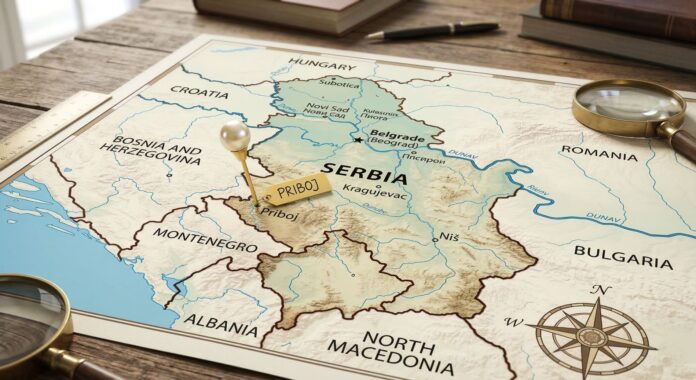
The Australian Exploration Company Middle Island Resources officially announced the establishment of a potentially large-scale gold deposit in the prospective Zabrnica section, part of the Priboj project in Western Serbia. This significant geological breakthrough outlines completely new horizons in front of the modern one mining industry in the Balkans. Through precise and systematic surveys, impressive geochemical anomalies have been identified, which quickly attracted the attention of investors, looking for new sources of gold ore.
Features of the new gold deposit
The identified prospect area, which looms as the future gold deposit, covering an impressive area with approximate dimensions of 600 meters long and 200 meters wide. This is a specific mountainous region, in which so far no modern ones have been held, high-tech geological surveys for prospecting for precious metals. Despite the lack of rich historical archives, the engineering teams of Middle Island Resources have been able to delineate a broad and distinct gold anomaly in the soil horizons.
Laboratory results are extremely promising for the potential of this primary ore occurrence. They show initial contents of the precious metal up to 0,68 y/t in massive rock outcrops on the surface. The data from the so-called. broken pieces of rock (float rocks), where the concentration reaches 1,91 g/t of gold, according to the official announcement to The Australian Stock Exchange (ASX). The main structural indicators, pointing to serious resource potential, include:
- Soil geochemical anomalies: Presence of significantly increased concentrations of gold in the surface layers, indicating the presence of hidden ore body in depth.
- Strong spatial consistency: Accumulation of precious metals is not sporadic, and follows a clear tectonic logic along the local faults.
- High potential for expansion: The boundaries of the anomalous zone remain open in several directions, which suggests an even greater scale of the geological phenomenon.
These primary indications give the specialists a serious reason to move on to the next one, a much more detailed research phase through deep probing.
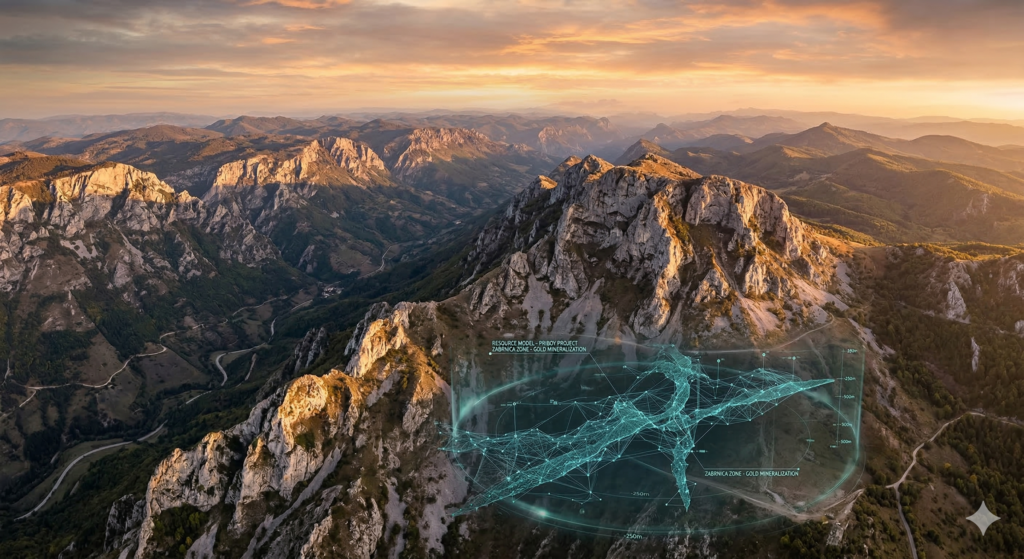
Scientific profile and origin of a gold deposit
From a strictly scientific point of view, metallogenic processes, led to the formation of this ore base, are of great interest to specialists in economic geology. The CEO of the company, Peter Spears, classified the discovery as potentially large-scale intrusive-related gold deposit (Intrusion-Related Gold Deposit – IRGD).
These specific deposits are formed, when hot magma from the deep layers of the earth's crust seeps up (intrusion), but it freezes, before reaching the surface. In its slow cooling and crystallization, the intrusion emits a highly heated, rich in metal hydrothermal solutions. These aggressive fluids circulate under enormous pressure through the cracks in the surrounding rocks (called host rocks), react chemically with them and deposit the gold in structural traps. The process of “substitution” means, that the primary minerals in the rock are literally dissolved and deposited in their place gold ore. It is not by chance that Spears compares the project to the multi-million dollar gold deposit Donlin Creek in Alaska - reference model c global geology for large-scale intrusive activity.
To conclusively prove his hypothesis and delineate the boundaries of the ore body, the company started a reverse circulation drilling program (RC – Reverse Circulation). This modern technology uses high pressure air, to extract rock chips quickly and efficiently to the surface, providing uncontaminated samples for accurate laboratory analysis.
Global context for every new gold find
The discovery in the Zabrnica section is not an isolated event, and is an integral part of the large-scale tectonic picture of The Western Tethyan metallogenic belt. This gigantic structural phenomenon, formed when the ancient Tethys Ocean closed, extends across the whole of South-Eastern Europe and has historically proven its ability to generate world-class deposits. Any new gold deposit in this region automatically positions the location on the radar of the largest multinational mining corporations.
The Western Tethyan Belt is already home to a number of active megaprojects, which fundamentally change the industrial landscape of the Balkans. Among them, they clearly stand out:
- The project Cukaru Peki and the remarkable discovery of Malka Golaya, operated by the Chinese giant Zijin Mining.
- The newly discovered deposit Choka Rakita of the Canadian company Dundee Precious Metals.
- The strategic and highly debated lithium project Yadar on Rio Tinto in Serbia.
- The Multimetal Project You are cooking on Adriatic Metals in neighboring Bosnia and Herzegovina.
Against the background of historically high prices of precious metals and geopolitical uncertainty on international exchanges, the meaning of similar European deposits grows exponentially. Localizing modern mining within Europe shortens supply chains and provides much-needed raw material independence to the Old Continent.
Forecast analysis for the future of this gold deposit
What really lies ahead in the medium and long term? The future of the Priboy project depends entirely on the results of the initial five RC wells. If laboratory samples confirm the presence of consistent gold deposit in depth with industrial contents of the metal, Middle Island Resources will launch a large-scale campaign to accurately calculate mineral resources and reserves according to strict international reporting standards (such as JORC or NI 43-101).
Except Priboy, the portfolio of the Australian company hides additional serious potential. Their project Bobia, also located in the western part of the country, recently revealed large-scale prospective targets for silver, lead, zinc and antimony in the Tisovik ore occurrence. At the same time, the Timok project in Eastern Serbia (a region with centuries-old mining traditions) complements the resource base. The successful proving of commercial reserves in Priboy will certainly catalyze fresh investments in the other sites as well.
Despite the optimism of the markets, investment risks in the exploration sector should not be overlooked. Geological uncertainty remains high until deep drilling is fully completed – surface geochemical anomalies do not always guarantee economic viability ore body under the ground. The dynamics of the local regulatory framework and licensing procedures will also play a key role in the successful transition to the stage of real mining.
Socio-economic impact of each gold deposit
The development of a modern mining site of this scale inevitably brings with it profound socio-economic transformations for the respective region. For the municipality of Priboy and surrounding settlements, the categorical confirmation of commercial viability gold deposit would mean powerful, a long-term boost to the local economy and infrastructure.
Opening a new one, a modern mine creates hundreds of direct jobs for highly qualified personnel - mining engineers, hydrogeologists, metallurgists and operators of automated heavy equipment. However, the economic multiplier effect is even more significant - it has been proven, that for every direct mine job, between three and five new positions are created in related service sectors such as logistics, specialized construction and local services.
Despite the massive economic benefits, sustainable development must remain an absolute and unconditional priority. Today's global mining industry is required to adhere to the strictest ESG standards (Ecological, social and managerial) standards. The responsible management of water resources, phased reclamation of affected land and strategic carbon footprint minimization are imperatives for operating in the 21st century.
Geotopia opinion: The discovery of new ones, promising mineral resources in the Balkans is a definite proof of the huge and still undiscovered geological potential of our region. Such large-scale exploration projects represent an undeniable triumph for modern geological science and technological progress. However, we firmly believe, that industrial growth should not come at any cost or at the expense of nature. The future belongs only to that type of mining, which integrates the highest environmental standards from the very beginning of the design phase. Only through absolute transparency, continuous and honest dialogue with local communities and uncompromising implementation of green innovations, the riches of the earth's subsoil can become a real engine for social prosperity and sustainable development, without endangering our priceless natural heritage.