



Artificial intelligence seems like an intangible technology, but behind its algorithms are data centers, power electronics and three highly concentrated supply chains—gallium, rare earth elements and tantalum.
Artificial intelligence is usually associated with algorithms, chips and vast arrays of data. However, its physical infrastructure begins long before the production of processors — from geological surveys, extraction and processing of the necessary mineral raw materials.
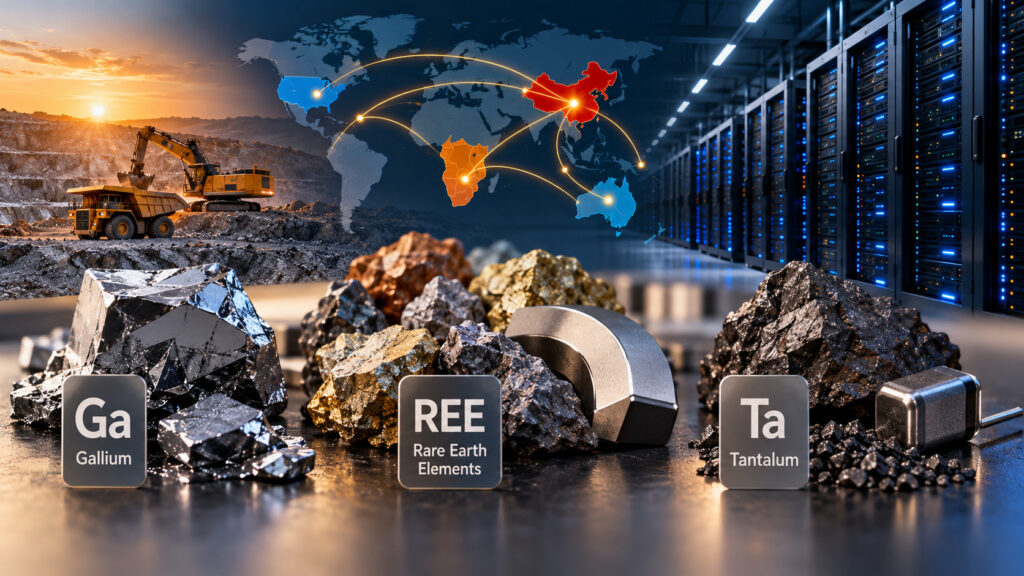
In his World Development Report for 2026 G. The World Bank indicates galia, rare earth elements and tantalum as indicative examples of the concentration in the chain of artificial intelligence. These are not the only raw materials, needed for AI, but their supply depends on a limited number of countries and manufacturers. worldbank.org
Artificial intelligence has a material basis
Every data center contains a huge amount of electronic equipment, cooling systems, servers, converters, cables and power management devices. Copper is needed for their production, silicon, aluminum, gold, silver, tin, bald, tantalum and various rare earth elements.
Therefore, the growth of AI does not only increase the demand for electricity and advanced chips. It also puts the mineral chains under pressure, which provide the materials for the hardware itself.
Geotopia has already addressed this link in the analysis "From the smartphone to the operating room: the invisible role of mining'. The digital world can seem virtual, but its basis remains entirely physical.
The Gaul: Chinese dominance in processing
According to Mineral Commodity Summaries 2026 of the US Geological Survey China provides approx 99% of the world's primary production of low-purity gallium. Clarification is important here, that it is a processed material, and not for a share of the world's geological reserves. USGS.gov
Gallium is not usually mined from standalone gallium mines. It is recovered as a by-product in the processing of bauxite and some zinc raw materials. Therefore, control over its production depends not only on the availability of a resource, and the scale of the aluminum industry, extraction technologies and downstream treatment capacity.
Gallium nitride and gallium arsenide are used in high efficiency semiconductors, radio frequency components and power electronics. These materials can operate at high voltages and temperatures, making them valuable for power-hungry equipment, including the systems around servers and data centers.
The rare earth elements: the power is in the entire circuit
According to data, used by the World Bank, China formed approx 69,2% of the estimated world production of rare earth elements in 2025 G. The USA follows with 13,1% and Australia with 7,4%.
However, this is only the yield. China has even stronger positions on partition, the refining and manufacturing of permanent magnets. It is this complex industrial capacity that is more difficult to replace than the ore itself.
Rare earth elements are a group of 17 chemical elements with various applications. Neodymium and praseodymium are used in powerful permanent magnets, and terbium and dysprosium can improve their performance at high temperatures. Such magnets are used in electric motors, ventilators, cooling systems and various components of high-tech equipment.
The risk of concentration is no longer theoretical. In April 2025 G. the Chinese Ministry of Commerce introduced license controls on the export of certain products, associated with medium and heavy rare earth elements. Restrictions do not mean a total ban, but give Beijing the ability to influence the speed and terms of supplies. english.mofcom.gov.cn
The tantalum: a small component of great importance
With tantalum, the geographic center is shifting to Africa. The Democratic Republic of the Congo provides approx 52% of the estimated world yield, and Rwanda and Nigeria — respectively approx 16% And 15,6%.
Tantalum is used in the production of compact capacitors with high reliability and stable electrical characteristics. They have application in servers, telecommunications equipment and power management systems, where the failure of a small component can affect a much more expensive system.
This chain also raises the question of the origin of the raw material. Some of the mining in Central Africa is associated with difficult traceability, informal operations and areas with security problems. Therefore, increased production must go hand in hand with reliable certification, supplier control and responsible sourcing.
Who actually controls the raw key
The answer does not boil down to one country. China has a near-monopoly position in primary processed gallium and a leading position in rare earth elements. Central Africa dominates tantalum mining, and Western countries and Asian technology centers control much of the chip design, the equipment and the final AI systems.
The real power belongs to those, which are involved in more stages of the chain:
- have reliable geological data;
- develop deposits and ensure extraction;
- possess separation and purification technologies;
- manufacture specialized materials and components;
- have access to energy, capital and markets.
Having a resource in the ground is not enough. No processing facilities, technologies, specialists and customers it does not create a strategic advantage.
Europe recognized the risk, but results will take time
The Gaul, tantalum and light and heavy rare earth elements are included in the list of critical raw materials of the European Union. The European Commission defines criticality according to economic importance and the risk of supply disruption. single-market-economy.ec.europa.eu
The European Critical Raw Materials Act puts up 2030 G. goals at least 10% of the annual consumption of strategic raw materials to be provided through European extraction, 40% — through processing in the EU, A 25% — by recycling. No more than 65% of the consumption of the relevant strategic raw material at a certain stage of processing must come from a third country.
These goals are important, but by themselves they will not create new mines and factories. Geological surveys are required, capital, technologies, specialists and clear permitting procedures. More on the subject can be read in the Geotopia review "Europe declares critical raw materials a strategic priority".
What does this mean for Bulgaria?
Bulgaria should not claim, that it has all the raw materials, that the AI industry needs, without this being proven by modern studies. However, the country has traditions in geology, ore miner, metallurgy and technical education, which can be turned into a real competitive advantage.
The first necessary step is to update the geological data and encourage new research. Next is the connection of extraction with processing, material science, the recycling and production of components with higher added value.
In the age of AI, commodity policy is no longer a peripheral topic. It is part of the technological, industrial and national security.
Geotopia opinion
Artificial intelligence does not start with the algorithm. It starts with geology, from the discovery of the resources and from the industrial ability to process them into materials of the required purity.
Europe will not achieve technological independence, if it continues to consider mining as an activity, which can simply be taken outside its borders. Recycling and replacement are necessary, but they cannot meet the rapidly growing demand on their own. New studies are needed, responsible mining, competitive processing and actual production of components.
The raw key to the future of AI will not necessarily belong to the countries with the most resources, and those, who manage to build the entire chain — from the rock to the high-tech product.