


Bulgaria has the geological potential to be part of the new European and global race for critical raw materials, but without modern studies, our country risks remaining only an observer in the process, which is already reordering the world economy.
The topic of rare earth elements and critical raw materials is no longer just a technical matter for geologists, mining engineers and industrial companies. It is becoming one of the great strategic issues of the 21st century — along with energy security, digital transformation, defense and the green transition.
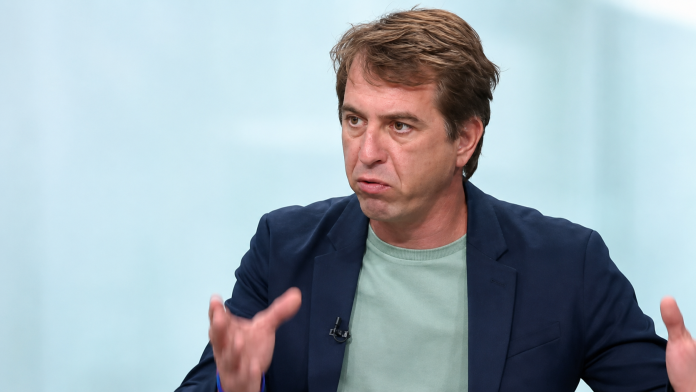
It is in this context Assoc. Stefan Velev from the Faculty of Geology and Geography of Sofia University commented before NEW NEWS, that Bulgaria has a chance to use its geological potential, but the key problem is the lack of enough new and targeted studies.
The global context: The G-7 is looking for a way out of dependence on China
The reason for the conversation is the decision by the G7 countries to take more coordinated action to reduce their dependence on a single dominant supplier in rare earths and permanent magnets. IN the official declaration of the G-7 a target to 2030 G. dependence on a single supplier outside the G-7 and partner countries for rare earth elements and permanent magnets to be reduced below 60%, with the ambition to subsequently reach a threshold of 50%.
This is not just a political statement. Rare earth elements are needed to make permanent magnets, electric cars, wind turbines, drones, radars, sensors, industrial robots, defense systems and high-tech electronics. Therefore, the question is no longer just who has deposits, and who controls the entire chain — from geological exploration and mining to processing, the separation, refining and manufacturing of final components.
As Geotopia has already covered in the analysis "G-7 wants to limit dependence on China for rare earth elements", the strategic objective of Western economies is clear: more security, more diversification and less vulnerability in critical minerals.
Why are rare earth elements so important?
Rare earth elements are often mistaken for an "exotic" group of metals, which are far from everyday life. In fact, they underlie many of the technologies, which already define the modern economy.
According to International Energy Agency markets for critical minerals are becoming increasingly concentrated, especially in processing and refining. That's what it means, that even a country or region has deposits, real strategic power comes from the ability to build a complete industrial chain.
In a separate IEA analysis of the rare earth elements is emphasized, that they are key to energy technology, electronics, aerospace and defense. Therefore, the topic is no longer only economic, but also geopolitical.
The Bulgarian question: do we know what is in our bowels?
In his interview, Stefan Velev poses one of the most important questions for Bulgaria: our country has traditions in the extraction of copper, lead, zinc and other minerals, but for the rare earth elements, a sufficiently clear and up-to-date picture is lacking.
The problem is not necessarily, that Bulgaria has no potential. The problem is, that without new geological surveys we cannot know where, what and in what quantities is there. And without such information, there can be no investment decisions, nor industrial strategy, nor real participation in the European chain for critical raw materials.
This is the key difference between resource potential and economic opportunity. Potential becomes reality only when proven through science, field work, drilling, laboratory analyses, modeling and publicly reliable geological information.
Geotopia has already addressed this logic in the material as well "The road from rock to metal", where we followed how a mineral resource goes through a long process — from initial discovery to real industrial value.
Manganese as an example of a missed or forgotten opportunity
In the conversation with NOVA, Stefan Velev also draws attention to manganese, a raw material widely used in steel production, batteries and industry. According to him, Bulgaria has traditions and known deposits of manganese, including in North-Eastern Bulgaria.
Manganese is not a rare earth element, but it is a good example of the wider problem: if a country does not maintain an active geological and raw materials policy, even known resources may remain economically unused. In modern industry, raw materials are not just 'ores in the ground', but part of complex value chains, related to technology, energy, transport and defence.
Therefore, the conversation about critical minerals should not be limited to rare earth elements. It includes honey, lithium, nickel, cobalt, graphite, manganese and a number of other raw materials, without which energy and digital transformation are impossible.
Green transition without mines? A less and less realistic idea
One of the most important emphases in Stefan Velev's position is the criticism of the image, that the green transition can happen without extracting minerals. This is a topic, which Geotopia consistently addresses in the analysis as well "Can Europe be green without its own mining?"?“.
The solar panels, wind turbines, electric cars, the batteries, the electricity transmission infrastructure, data centers and artificial intelligence do not exist in a vacuum. They require huge amounts of metals and minerals. In this sense, the debate "for" or "against" mines is too simplistic. The real question is what yield do we want — old, opaque and risky, or modern, technological, regulated and subject to strict environmental control.
.The European framework is already in place
The European Union is already trying to respond to this dependence by The legislation on critical raw materials. It has goals up to 2030 G. EU to provide at least 10% from its annual consumption of strategic raw materials through its own extraction, 40% by processing within the Union and 25% through recycling.
These goals show, that Europe no longer sees raw materials as a peripheral industrial issue, but as part of the continent's strategic autonomy. For Bulgaria, this is an opportunity, but also a warning. If our country does not invest in geological knowledge, in modern studies and in a clear policy towards critical raw materials, other countries will take its place in the chain.
Bulgaria needs a new raw material culture
The discussion about critical raw materials in our country is often met with mistrust of the mining industry. This mistrust has its historical reasons, but it cannot be the only basis for future policy.
A modern approach should include:
- modern geological surveys;
- publicly available and up-to-date information;
- clear environmental standards;
- transparent procedures;
- technological control;
- participation of local communities;
- relationship between yield, the processing, science and industry.
Without these elements, Bulgaria cannot be a serious participant in the European policy for critical raw materials. But with them, the country can use its geological tradition and turn it into a new economic advantage.
The new studies are the first step
The most important conclusion from Stefan Velev's position is, that Bulgaria cannot rely only on old data, historical sites and general assumptions. Raw materials policy starts with knowledge. And knowledge begins with research.
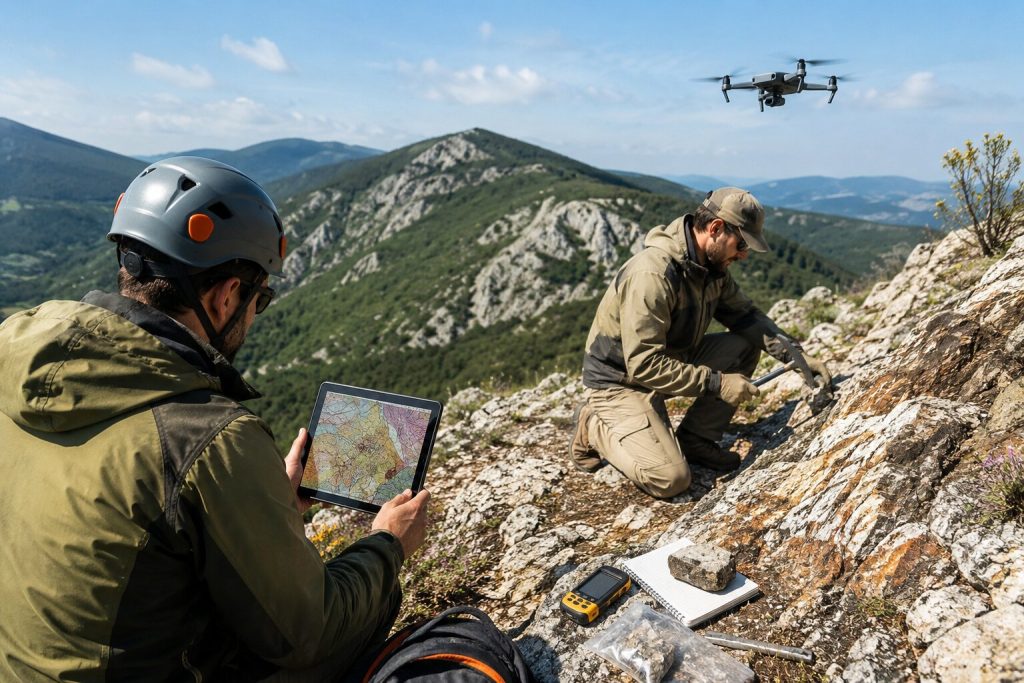
Satellite data is already being used around the world, drones, artificial intelligence, three-dimensional modeling, geochemical analyzes and high-tech laboratory methods for the discovery and evaluation of mineral resources. Geotopia considered this direction in the material as well "Drones in Geological Surveys", where it became clear, that new technologies are changing the way, by which we seek and value the resources of the future.
Therefore, the question before Bulgaria is not whether to join the global race for critical raw materials. The question is whether he will do it in time.
Geotopia opinion:
Stefan Velev's comment raises a very important and timely question: Bulgaria cannot be part of the new European raw materials policy only with good intentions and historical memories of a mining tradition. Current geological data is required, modern studies and a clear state strategy.
Critical raw materials are not an abstract topic. They are the material basis of electric cars, wind turbines, the batteries, artificial intelligence, defense industry and technological independence. If Bulgaria wants to be not only a consumer, but a participant in this new economy, the first step is knowing what you own.
So the message is clear: without new geological studies, there can be no new raw materials policy. And without a raw material policy, Bulgaria risks missing one of the most important economic opportunities of the coming decades.



A very timely conversation. In the context of European critical raw materials policy, geological exploration is no longer just a scientific activity, but a matter of economic and strategic security. Bulgaria has considerable potential, but without current geological data, long-term vision and public dialogue, this potential can hardly be realized. It is important to discuss the topic professionally and based on facts, because sustainable development begins with a good knowledge of resources, that we have.