


The world of high technology is facing a major upheaval, having recently been mapped colossal critical minerals under an already operated mine in Asia. This strategic geological find not only redraws the global resource map, but also challenges existing supply chains for key raw materials.
At Maoniupin Mine, located in Mianning County of Sichuan Province, has been going on for years extraction of rare earth elements, which power production hubs in Europe, North America and Asia. However, the new estimates reveal a scale, which exceed all previous forecasts of specialists.
How Sichuan's New Critical Minerals Stun Geologists
As the geological survey teams completed their latest round of assessments earlier this year, they come across data, which literally rewrite the economic geology textbooks. Under the already developed layers lies a reserve of rare earth oxides, which increases the total proven resources of the complex to impressive 10.4 million tons.
The discovery of these additional 9.7 million tons is no accident. It is the result of decades of precision, deep research and methodical mapping of the earth's bowels. It's even more impressive, that drilling also identifies staggering amounts of others industrial minerals – 27.1 million tons of fluorite and 37.2 million tons of barite.
Such concentrations are classified by experts as "oversized deposits". They turn a single mining complex into a multifunctional center, capable of simultaneously powering three completely different, but equally important technology sectors.
Scientific profile of discovered resources
To understand the true value of this find, we must consider the physicochemical properties of the raw materials found, which go beyond our hitherto known limits of application:
-
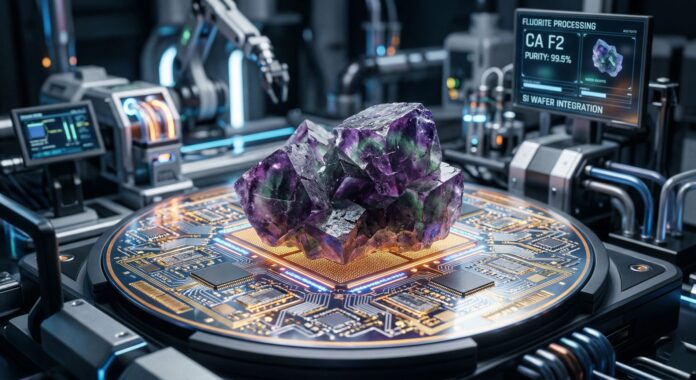
Fluorite (CaF₂): Also known as fluorspar, this mineral is a critically important source of industrial fluoride. Thanks to its cubic crystal structure and high transparency, it is indispensable in metallurgy as a flux and in the manufacture of hydrofluoric acid. In the technological sector, fluorine compounds are absolutely mandatory for etching and cleaning silicon wafers in the production of semiconductor components, as well as for the creation of electrolyte formulas for lithium-ion batteries.
-
Barite (BaSO₄): Composed of barium sulfate, the mineral is characterized by an extremely high density (specific gravity 4.5). This makes it the perfect thickening agent for drilling fluids. Without it, modern deep drilling for oil and gas, including shale mining, would be impossible due to the enormous risk of the wells blowing out.
-
Antimony (Sb): Found in neighboring Gansu Province (over 51 000 tones), this metalloid is key flame retardant. It improves the fire resistance of printed circuit boards, cables and military equipment, becoming the standard for industrial safety.
Global context and critical minerals market
The discoveries in Sichuan and Gansu do not happen in a vacuum; they have a direct bearing on global geopolitics and economics. While countries like USA and India also have deposits of barite and other raw materials, the scale and complex nature of China's reserves give the Asian nation an unprecedented market advantage.
According to reports from leading international energy agencies, the concentration of mining and processing in one point creates serious vulnerabilities for global supply chains. For manufacturers in Europe, Japan and South Korea this means a deepening dependence on a single supplier.
| Rank | Country | Reserves of rare earth elements (metric tones) |
| 1 | China | 44 000 000 |
| 2 | Brazil | 21 000 000 |
| 3 | India | 6 900 000 |
| 4 | Australia | 5 700 000 |
| 5 | Russia | 3 800 000 |
| 7 | USA | 1 900 000 |
The data reflect global reserves to 2025 G., highlighting the leader's huge lead.
Beijing's monopoly and leverage
These colossal reserves are increasingly used as a geopolitical tool. The introduction of export restrictions on seven rare earth elements and permanent magnets, as well as the requirement for special export licenses, are a clear signal of a change in the rules of the game. Issuance of long-term licenses for Europe, while exports to the US remain subdued, shows how control over these strategic raw materials it can be used to exert economic pressure and rearrange trade partnerships.
Socio-economic impact of mining critical minerals
The large-scale extraction of these materials brings with it enormous economic benefits as well, as well as serious challenges for sustainable development. Locally, the expansion of the Maoniupin mining complex creates thousands of new jobs in the sector heavy industry and logistics. This stimulates the regional economy, but it also puts enormous pressure on the environment.
The ecological footprint from the processing of rare earth oxides and the release of fluorite requires strict waste water management and control of toxic emissions. To strike a balance, the mining industry must urgently invest in closed water cycle technologies and reclamation of disturbed terrains, otherwise, the long-term environmental damage may outweigh the short-term economic dividends.
Critical Minerals Market Forecast Analysis to 2035 G.
Looking forward to the next ones 5 to 10 years, the market of critical minerals will be defined by the battle between technological dependence and the drive to diversify.
-
Growing demand: The energy transition and the boom in artificial intelligence will triple the need for semiconductors and high-capacity batteries, which ensures a secure market for fluorite and rare earth metals.
-
Technological innovations: Rapid development is expected in the field of e-waste recycling (urban mining) as an alternative source of antimony and neodymium.
-
Geopolitical risk: Western economies will accelerate their investments in the exploration of new deposits in Africa and South America, trying to circumvent the Asian monopoly. However, due to the complex refining processes, the dominance of the current leaders in processing will be difficult to overcome in the next decade.
After all, the Maoniupin complex becomes a symbol of the new industrial age – a place, where geology dictates the pace of global technological progress.
Geotopia opinion: In the era of unprecedented technological growth and green transition, the discovery of ultra-large mineral reserves is a double-edged sword. On the one hand, it is a triumph of geological science and a guarantee of the raw material security of future innovations. On the other hand, the absolute concentration of resources poses huge geopolitical risks and poses serious environmental challenges. Real progress is not just measured in millions of tons of ore mined, and in our ability to manage these processes sustainably, with nature in mind and fair access to technology. A balance between industrial hunger for raw materials and responsibility to the planet is the only way forward.