


Chinese researchers recently located large-scale new deposits of rare earth elements in the northeastern provinces of Heilongjiang and Jilin, which have the potential to completely rewrite the rules of the global mining industry. This strategic discovery, released by the Institute of Geology and Geophysics of the Chinese Academy of Sciences, not only promises significantly greener operation, but also firmly cements Beijing's geopolitical hegemony in the global supply of critical raw materials. In the conditions of an accelerated global energy transition, these innovative geological resources are the absolute foundation of tomorrow's high-tech industry and defense.
Geological profile: Why the new rare earth elements are unique
For decades, the global industry relied mostly on celebrities, clay-rich ion-adsorption deposits in South China. Unlike them, the new geological formations in the north were formed by a completely different and fascinating natural mechanism. Instead of the classic deep chemical weathering in warm and humid climates, these specific northern resources are the product of repeated harsh cycles of freezing and thawing over millions of years. This cryogenic process has literally broken the hard alkaline granites into loose sands and gravels.
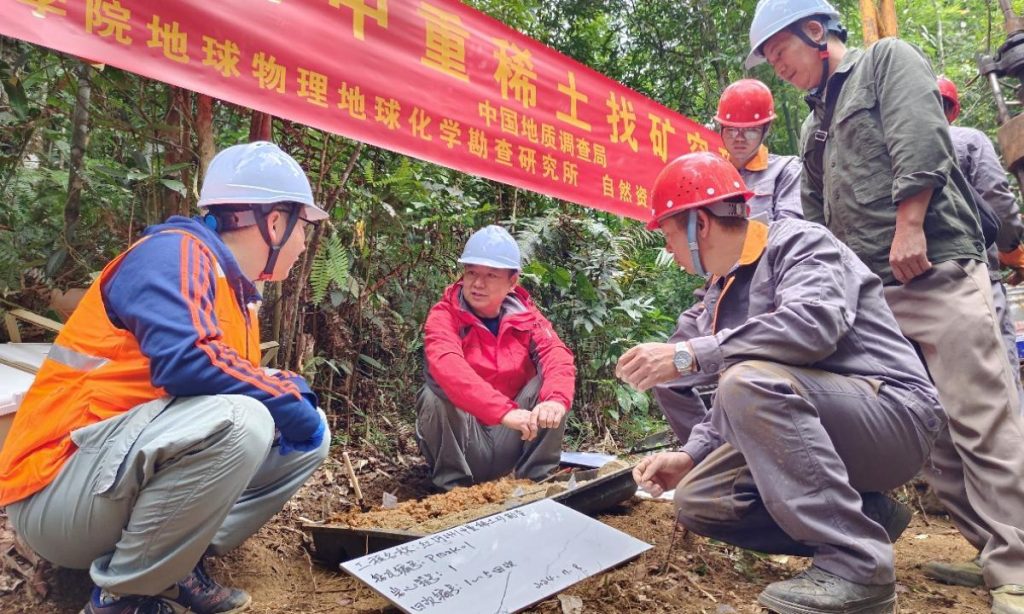
That's what it means, that the precious metals are found in separate, free mineral particles, mostly in the form of phosphate minerals monazite And xenotime. Xenotime is extremely important, as it is a major source of heavy lanthanides, including the critical yttrium for high-tech applications. From a strictly scientific point of view, the presence of free mineral phases allows the use of mechanical gravity or magnetic separation, which is a true revolution in enrichment.
The main technological advantages of this new type of dispersed formations include:
- Extremely high concentration: Deposits show enrichment of both mild (lanthanum, cerium, neodymium), as well as extremely deficient heavy lanthanides.
- Physical accessibility: The natural mechanical disintegration of rocks dramatically reduces the need for energy-intensive and expensive open pit blasting.
- Maximum process efficiency: In traditional chemical methods up to 25% of the valuable raw material may remain encapsulated and unused, while here the retrieval rate is times more reliable.
- Eliminating complex chemistry: The need for aggressive chemical leaching is avoided, which is the weakest link in the practices so far.
For the experts and analysts, which follow the development of sustainable mining, this breakthrough clearly demonstrates the importance of rethinking traditional metallogenic models for the search for critical minerals.
Global Rare Earth Market: The hegemony of Beijing
To date, the world market and supply chains are almost entirely dependent on the production capacity of a single country. International statistics are uncompromising: China controls over 60% from global primary production and subsoilers 90% of the world's processing capacity, separation and refining of rare earth elements. Every new large-scale geological discovery on their territory has a direct, shock effect on international markets.
These strategic materials are not freely traded on traditional commodity exchanges in the same simplistic manner, like the base metals, whose live prices investors monitor daily. They are raw materials of critical importance to national security, which dictate the development of key industrial sectors. Electric cars, high performance industrial lasers, offshore wind turbines and the most advanced defense systems are absolutely unthinkable without permanent magnets, based on neodymium, dysprosium and terbium.
Until recently, geologists thought, that the heavy fractions, which are the rarest, scarce and expensive, are concentrated exclusively in southern Chinese provinces such as Jiangxi and Guangdong. The discoveries in the north decisively break this long-standing paradigm. According to in-depth analyzes of International Energy Agency (IEA), the demand for these specific metals will increase manifold to 2040 year. Locating diversified resources within China itself gives the country unprecedented geopolitical leverage.
Socio-economic dimension and ecological balance
The industrial extraction of raw materials has always been a complex balance between the pursuit of economic gain and the imperatives of environmental protection. In the traditional extraction of metals from southern ion-adsorption clays, a process of in-situ chemical leaching by ammonium sulfate. This outdated method is not only slow and capital intensive, but also carries a huge risk of environmental catastrophes, leading to severe contamination of groundwater and degradation of fertile soils.
The new northern deposits in Heilongjiang offer a radically different and much more positive socio-economic outlook. The fact, that the ores allow direct mechanical separation, changes the rules of the game:
- Compact ecological footprint: The absence of massive amounts of toxic reagents in the primary mining cycle protects sensitive local ecosystems and watersheds.
- Optimization of operating costs: Significantly lower capital investment for treatment facilities and reclamation make mining projects highly cost-effective.
- Transformation of employment: Highly qualified engineers and operators of modern mechano-separating equipment are required, which raises the standard of living in the region.
- Alleviating social pressure: A cleaner and more transparent industry generates less opposition from environmental organizations and builds trust among the local population.
This geological discovery is visual proof, that technological progress in the earth sciences can go hand in hand with modern concepts of responsible business. Increased efficiency means, that the mining industry is capable of satisfying the enormous hunger for materials, needed by green energy, without irrevocably compromising nature.
Predictive analysis: The future of rare earth metals
What is actually coming next 5 to 10 years? Successful explorations in northern China are sure to catalyze profound structural changes in the global economy. First of all, colossal capitals are expected to be diverted to development activities (R&D) and implementation of innovative technologies for physical separation, specially adapted for cold climate zones.
In second place, the global market of rare earth elements will become increasingly polarized and competitive. While China will be able to offer cleaner, more sustainable and potentially cheaper raw materials thanks to these new deposits, competitors in the US, Australia and the European Union will be hard pressed to accelerate and subsidize their own research programs. The strategic risk for Western industry lies in potential targeted oversupply by Beijing, which could artificially drive prices down to levels, making alternative western mining projects unviable.
Despite geopolitical friction, the technological potential remains enormous. These new ones, readily available stocks will ensure long-term stability in the production of electromobility components. Moreover, scientific progress in the recognition of dispersed mineral formations will undoubtedly stimulate a targeted search for analogous geological structures in other regions of the world with a similar cryogenic history, like Canada, Greenland and Scandinavia.
Geotopia opinion: In an era of unprecedented technological transition, independent and objective information is the most valuable public resource. As media, whose main purpose is to inform the public without corporate filters, we believe, that large-scale processes in the mining industry must be analyzed deeply and impartially. Discoveries of new deposits are too often exploited solely through the prism of quick corporate profits or early-signal geopolitical fears. However, the real progress of mankind lies in the rigorous scientific approach - that type of innovation, which enable natural resources to be intelligently managed, responsibly and with future generations in mind. When the geology itself provides us with a unique chance for cleaner and highly efficient extraction, it is the absolute duty of the industry to realize this potential without compromising the environment. Sustainable development has long been more than just an aspirational regulatory framework; it is the only logical and possible way forward, in which engineering thought, economics and environmental responsibility function in absolute sync.



He who explores finds!
In Bulgaria, the stage of geological studies is almost absent. The reason is the heavy bureaucratic machinery of the institutions, which forces Bulgarian geologists to search in other countries