

In public debate, the convenient often prevails, but a false opposite “or nature, or mining'. Real European experience shows otherwise: the countries with some of the highest environmental indicators in the world do not eliminate the extraction of raw materials. They put it under strict permitting regimes, scientific evaluations, publicity, monitoring, financial guarantees and reclamation obligation.
This is not just a political statement. Sweden, Finland, Norway, Germany, France, Austria, Spain, Portugal and Ireland are cited as some of the greenest countries in Europe and are among the leading European countries in international environmental assessments such as Environmental Performance Index. That is why their experience is particularly telling: high environmental ambitions do not exclude the development of own mining, but they put stricter rules before him, control and public requirements.
All of these countries have active mining or are developing new projects for strategic raw materials.
This fact does not prove, that every mine is safe or that every project must be approved. It proves something more important: high environmental protection and the mining industry are not initially incompatible. Technology is decisive, water and waste management, impact on biodiversity, post-closing control and liability.
Europe is not giving up raw materials - it is changing the rules for their extraction
The European Union now officially considers access to raw materials as a matter of economic security, energy transition and industrial sustainability. The European Critical Raw Materials Act sets specific goals for 2030 G.:
- least 10% of the annual consumption of strategic raw materials in the EU to be provided by mining in the Union;
- least 40% to be processed in the EU;
- least 25% to come from recycling;
- no more than 65% from the consumption of each strategic raw material at the relevant stage of processing to depend on a third country.
In March 2025 G. The European Commission approved 47 strategic projects on the territory of the EU, and in June of the same year – more 13 the project in third countries and overseas countries and territories. They cover mining, processing, recycling and substitution of raw materials. The official list of the European Commission includes lithium mining projects, honey, nickel, cobalt, tungsten, graphite, rare earth elements and other materials in Sweden, Finland, France, Germany, Spain and Portugal.
As of July 2026 G. the second reception of applications is over. The commission reported on 95 statements from the EU and 66 outside of it. That doesn't mean, that all will be approved. However, it shows the direction: Europe is not planning an economy without mineral raw materials, and more sustainable, diversified and controlled raw material base.
The reason is the material reality of the green transition. According to International Energy Agency a typical electric car requires about six times more mineral resources than a conventional car, and an onshore wind power plant – about nine times more than a gas plant of similar power. From 2010 G. the average amount of minerals, required for a unit of new electricity generating capacity, has grown with 50%.
Therefore, the green transition does not eliminate mining. It increases the need for mining to be technologically superior, environmentally safer and socially more transparent.
Sweden: 13 operational metal mines and a new raw material security policy
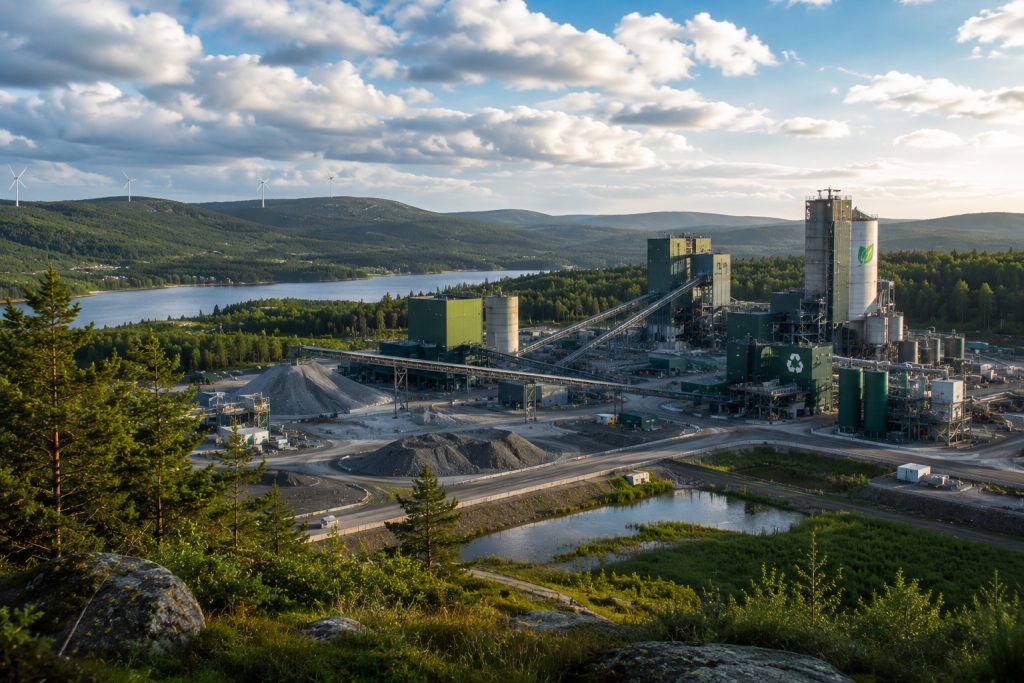
Sweden is undoubtedly among the countries with the highest environmental indicators in the world, but at the same time it remains a leading mining country in the European Union.
The latest statistical report of Swedish Geological Survey – SGU points out, that through 2025 G. in the country they worked 13 metal mines. Sweden mines iron ore, honey, zinc, lead, gold and silver and provides the majority of iron ore production in the EU.
This is not a relic of the industrial past, which the country is trying to close. In July 2026 G. the Swedish government presented a new mineral strategy, which links access to metals to national security, defense and the sustainability of European industry. The strategy provides for more predictable procedures, investments in geological exploration, development of processing and a more active state role. Geotopia already reviewed in detail why Sweden made critical raw materials a national security priority.
The important clarification is, that an expedited procedure does not mean automatic clearance. Projects continue to be subject to environmental assessments, consultations and national and European environmental legislation.
Finland:41 working mines and the largest primary gold mine in Europe
Finland is fourth in the world in the Environmental Performance Index. At the same time, it has a developed gold industry, nickel, honey, cobalt, chromium and industrial minerals.
According to the current report of the Finnish authority Tukes за 2025 G. 22 companies reported a yield of 41 mini, of which 9 are metallurgical . They were mined during the year 28,7 million. tons of metal ores, and investments in mining and beneficiation reach 439 million. euro. Among the objects with the most significant investments are Kevitsa, Siilinjärvi, Kittilä and Terrafame.
The Kittilä underground mine in Lapland has been designated by operator Agnico Eagle as the largest primary gold mine in Europe. Prez 2025 G. she produced 217 379 troy ounces of gold, or approximately 6,76 tones.
The Finnish example is particularly indicative: high environmental standards have not led to the abandonment of mining, and to the system, in which the permits, the investments, safety and environmental costs are reported and controlled by specialized institutions.
Norway: ambition for "the world's most sustainable mineral industry"
Norway is not a member of the EU, but it is part of the European Economic Area and an important participant in the European raw material chains. The country is eighth in the Environmental Performance Index for 2026 G.
Instead of declaring mining incompatible with its fjords, natural areas and climate objectives, the Norwegian government accepted national mineral strategy with Norway's ambition to develop "the world's most sustainable mineral industry". The country has production of industrial minerals and titanium raw materials, including the long-standing ilmenite mine at Tellnes.
Wording is essential. Norway does not promise impact-free mining - there is no such thing. It aims to minimize the impact, managed and subject to high technological and environmental requirements.
Germany and Austria: industrial raw materials, salts and tungsten
Germany is sixth in the Environmental Performance Index, but continues to extract significant amounts of its own raw materials. According to the German Mining Transparency Initiative D-GO through 2023 G. the party has received 33,9 million. tons of potassium salts, 12,5 million. tons of rock salt and industrial brines, 44,7 million. tons of limestone, marl and dolomite and hundreds of millions of tons of sand, gravel and crushed stone.
This does not solve Germany's dependence on imported metal raw materials, but disproves the notion, that the developed green industrial state functions without mining. In addition, among the EU's strategic projects is Germany's Zero Carbon Lithium - lithium extraction project, which still needs to go through all applicable permitting procedures.
Austria offers one of the clearest European examples. The past Mittersill in the province of Salzburg mines scheelite ore for the production of tungsten. After initial open pit mining in the 1970s by 1986 G. it only works underground. The ore is transported to the concentrator via an underground conveyor system, and the site is located next to Hoe Tauern National Park.
This example does not mean, that proximity to a protected area is irrelevant. On the contrary, it requires stricter control and technical solutions. But it shows, that in Austria the issue is resolved through specific conditions and technologies, and not by the presumption, that any mining activity is impermissible.
Ireland: Tara is producing zinc again
Ireland remains important to European zinc production.
The underground Tara Mine near Navan is one of the largest zinc mines in Europe. After a conservation period from July 2023 G. until October 2024 G. production was restored. According to data from Boliden in 2025 G. they are in Tara processed 1,44 million. ore tones, and the planned production target is 1,8 million. tons per year with the prospect of an increase to 2,2 million. tones.
Zinc is key to galvanizing and protecting steel from corrosion, and from there – for the infrastructure, transport, energy and extending the life of metal products. Ireland does not choose between environmental reputation and industrial raw material. It requires mining to operate within relevant permitting and environmental obligations.
Spain: Andalusia is the second largest producer of honey in the EU
In the southern part of the country, Andalusia is the center of metal mining and the Iberian pyrite belt.
In his report from 2025 G. OECD points out, that Andalusia:
- provides 35% of the mining production of Spain;
- concentrate 30% of employment in the Spanish mining sector;
- forms about 90% from metal mining in the country;
- is the second largest producer of copper in the EU;
- she had 463 operating mining and quarry sites through 2024 G.
The report does not gloss over the challenges. The OECD recommends better coordination between institutions, more active participation of local communities, stronger monitoring and development of circular and more efficient technologies. This is precisely the European approach: not unconditional approval, and development under rules and corrections there, where control is insufficient.
Portugal: 3,1 million. tons of processed ore at Neves-Corvo per 2025 G.
Portugal is also an important part of the Iberian Pyrite Belt.
Neves-Corvo underground mine, operated by Somincor, produces copper concentrates, zinc and lead. According to Boliden's current data through 2025 G. there are processed approx 3,1 million. ore tones. The mine reaches a depth of approx 1100 meters and provides an average 1259 jobs.
The Lombador North Phase extension 2, Semblana and the third processing silo in Neves-Corvo is included among the EU's strategic projects to contribute to the supply of copper. The European list also includes Portuguese projects for lithium and processing of battery raw materials.
It shows, that country, known for its ocean coast, protected areas and strong tourism, does not accept the thesis, that nature can only be protected by giving up one's own mining.
France: strategically lithium, but not automatic permission
Imerys' EMILI project envisages integrated lithium mining and processing in the Allier department and through 2025 G. received strategic project status under the European Critical Raw Materials Act.
It is important to make a distinction here: EMILI is not yet an active mine, and strategic status does not replace environmental assessments and national permits. The project went through a public debate and ongoing consultation under the supervision of the French National Commission for Public Debate. Prez 2025 G. the project schedule and some of its parameters were changed.
This very process is proof of the real European model: a state may consider a raw material strategic and simultaneously require an assessment, publicity, corrections and proof of environmental acceptability.
Nature 2000 not an automatic ban – but the standard is high
One of the most frequently repeated myths is, that in an area of Natura 2000 there can be no economic or mining activity. The European Commission has explicitly developed procedure and special guidance for mining activities and Natura 2000.
Mining projects in or around a protected area are not automatically excluded. However, if they are likely to have a significant impact, they must pass an appropriate assessment by article 6, paragraph 3 from the Habitats Directive. The competent authority can approve them only if, on the basis of complete and reliable scientific information, it is established, that the integrity of the area will not be damaged.
Hence Natura 2000 it's neither an automatic yes, nor an automatic no. It is a regime of high burden of proof and environmental protection.
Recycling is mandatory, but it cannot replace mining
Europe is right to set a target for more recycling. Metals like copper can be reused many times, and the extraction of raw materials from old products and mining waste must be increased.
But recycling is limited by the amount of material, which has already been introduced into the economy, from the long life of the infrastructure and from the rapid increase in demand. It cannot be recycled metal, which has not yet been produced and put into a product. Therefore, primary extraction and the circular economy are not opposites, and two necessary sources of raw materials. Geotopia addressed this issue in the analysis as well "Copper - the metal, without which there is no green transition".
What the European examples actually prove
Sweden, Finland, Norway, Germany, Austria, Ireland, France, Spain and Portugal do not prove, that mining has no impact. Such a statement would be scientifically and socially incorrect.
They prove three more defensible theses:
- A country's high environmental performance does not require the elimination of the mining industry.
- The green and digital transitions increase the demand for metals and minerals, instead of canceling it.
- The right question is not "mine or nature", and whether the particular project can meet the strict technology requirements, water, waste, monitoring, emergency preparedness, reclamation and financial responsibility.
When a project cannot prove its eligibility, it should not be realized. But when the estimate is based on verifiable data, impacts are limited to acceptable levels, and the controls and guarantees are real, automatically declaring it an "ecological disaster" is not a scientific position.
Geotopia opinion
The modern world is like that, as we know it, it could not exist without mining. The apartments, the roads, power transmission networks, the cars, smartphones, medical equipment, digital communications and defense technologies depend on metals and minerals, extracted from the earth. The green transition does not cancel this dependence – it increases it. There are no electric cars, batteries, wind turbines and copper-free renewable energy, lithium, nickel, graphite, iron and rare earth elements.
It is indicative, that even the states, cited as the greenest in Europe and the world, they have not given up mining. Sweden, Finland, Norway, Germany, Austria, France, Spain and Portugal continue to extract raw materials or develop new strategic projects. These countries understand, that protecting nature does not mean giving up the material basis of modern civilization, and extraction under strict environmental rules, technological control and clear responsibility.
Geotopia's position is clear: not every mine should be accepted uncritically, but no project should be rejected simply because it is mining. Each project must be evaluated on a case-by-case basis, technology and proven impacts, bearing the full cost of environmental protection, safety, monitoring, reclamation and long-term liability.
The real choice is not between mining and modern life - because the latter cannot exist without the former. The choice is between dependence on mining with less control somewhere far away and own, responsible mining under strict rules, transparency and functioning institutions. The European model is not an abandonment of mining. It is a rejection of uncontrolled mining.



That's exactly what the conversation is about, which we must also conduct in Bulgaria - not an ideological dispute "for" or "against" mining, a professional assessment of each specific project.
There is no mining without impact, as there is no energy, transport, agriculture or construction without impact. The question is whether it has been scientifically evaluated, limited to permissible levels, controlled and secured with real responsibility, financial guarantees and reclamation.
European countries with the highest environmental standards do not automatically close their mines. They invest in geological exploration, develop new projects for strategic raw materials and at the same time set increasingly strict requirements for technology, the waters, the waste, biodiversity and safety.
This is particularly important for the green transition. Electric cars, power transmission networks, wind turbines, solar systems, batteries and digital infrastructure are not built with only good intentions. They need honey, lithium, nickel, zinc, tungsten, graphite, rare earth elements and a number of other mineral raw materials.
We can choose to mine some of them in Europe under strict environmental and social rules, or remain dependent on imports from countries, in which the standards, transparency and working conditions are often significantly lower.
Therefore, the right question is not "nature or mine". The right question is: can the particular project prove its safety with verifiable data, modern technologies, constant monitoring and clear responsibility throughout the life cycle?
When it cannot - it should not be allowed. When it can - it should not be rejected through fears, slogans and pre-judgments.