


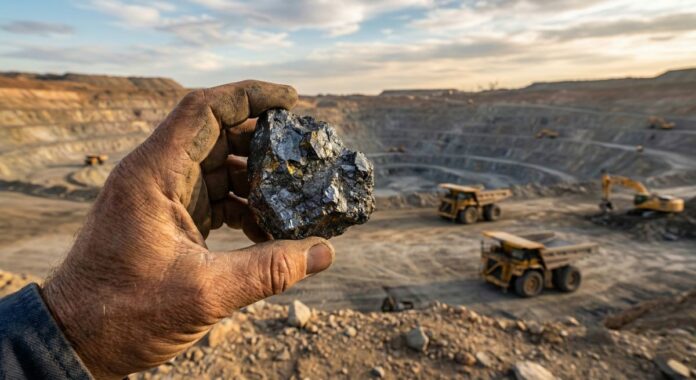
The ore road it begins deep in the bowels of the earth and undergoes a complex technological transformation, to turn into the metal, that builds our modern world. From the microchips in smartphones to the copper wires in electric cars and the steel structures of skyscrapers, every metal object is the result of precise geological science and large-scale engineering. This article will guide you through each stage of this exciting metamorphosis, revealing how raw rock becomes a strategic resource.
What is actually the path of the ore and the rock itself?
To understand the industrial cycle, we must first define the object of our interest. In geology, not every rock, containing metal, is classified as an ore. Ore is a natural mineral aggregation, from which the extraction of one or more metal components is economically feasible and technically possible.
The difference between ordinary rock and ore lies in the concept "useful component content" (grade). If the concentration of copper in a scale is below 0,3%, it is often considered a "blank slate" (waste rock). But if the content is above a certain threshold (cut-off grade), it becomes part of the balance reserves of the deposit.
Main components of the deposit:
- Minerals: Chemical compounds (for example, chalcopyrite for copper or hematite for iron).
- Accommodating scale: The material, which surrounds the ore body and usually has no economic value.
- Stocks and resources: The estimated amount of ore, which has been proven by drilling and analysis.
First steps in exploring any ore deposit
The geological survey is the foundation, on which the whole is built ore road. This stage is associated with high investment risk and requires exceptional expertise. It all starts with geological mapping and geochemical samples from the surface, which direct specialists to potential anomalies.
Modern geophysics allows scientists to "see" underground, using magnetic, electrical and seismic methods. When a target is identified, begins core drilling. The extracted cylindrical stone samples (nuts) are described in detail and sent to laboratories for chemical analysis. It is built on the basis of this data digital 3D model of the deposit, which visualizes the geometry of the ore body and the distribution of metals within it.
Production planning according to the type of each deposit
Once geologists confirm the presence of resources, the engineering teams have to decide how it will go ore path to the surface. The choice between open and underground mining it depends on the depth, the shape of the deposit and the economic parameters.
Open mining is applied, when the ore is near the surface. It allows the use of huge machinery and the achievement of large capacity, but requires the movement of significant amounts of land mass. Underground mining is more precise and has a smaller footprint on the landscape, but is associated with higher ventilation costs, strengthening and safety of work. A mine plan is a "live" strategy, which optimizes the seizure sequence, to ensure stability and profitability.
Technological process in the actual extraction of ore
When the preparation is complete, physical extraction begins. In modern mines, this is a highly automated process. Basic operations include drilling blast holes and controlled blasting to fragment the array. This is followed by loading with powerful excavators or front-end loaders into specialized mining dump trucks.
Transport is a critical unit. Conveyor belts are used in large facilities, which transport thousands of tons of material per hour, reducing diesel emissions. It is also done here the primary sort – sensor technologies can identify the metal content in the dumper bin and direct it to the factory or to the depot for temporary storage.
Preparation and mechanical processing of each ore
The ore, arriving from the mine, it is often in large chunks, which are not suitable for direct extraction of the metal. The next stage of ore path is the preparation, which includes crushing and grinding (comminution). The goal is to "free" the mineral grains from the host rock.
This is the most energy-intensive part of the entire cycle. The ore passes through jaw and cone crushers, and then enters huge mills (SAG and ball mills), where it is ground to a fine powder, often with particle sizes sub 100 the micron. This process is critical, because grinding too coarsely results in loss of metal, and too fine - to unnecessary energy consumption. Enrichment as a key stage in the entire path of the ore
Enrichment is the process, in which the valuable mineral is physically separated from the waste mass. The most common method for sulfide ores is flotation. Ground ore is mixed with water and specific reagents in large vats. Air is passed through the mixture, and the beneficial minerals "stick" to the bubbles and float to the surface in the form of mineralized foam.
Other methods include:
- Gravitational enrichment: Uses the difference in specific gravity (often with gold and tin).
- Magnetic separation: For iron ore and magnetite.
- Sensory sorting: Modern X-ray or laser sensors, which separate the ore "piece by piece".
The result of this stage is concentrate – a product with a high metal content (For example 25-30% copper as raw material 0,8%). The rest, called tail, is transported to specially designed facilities (tailings dumps).Metallurgical processing and final refining of metals
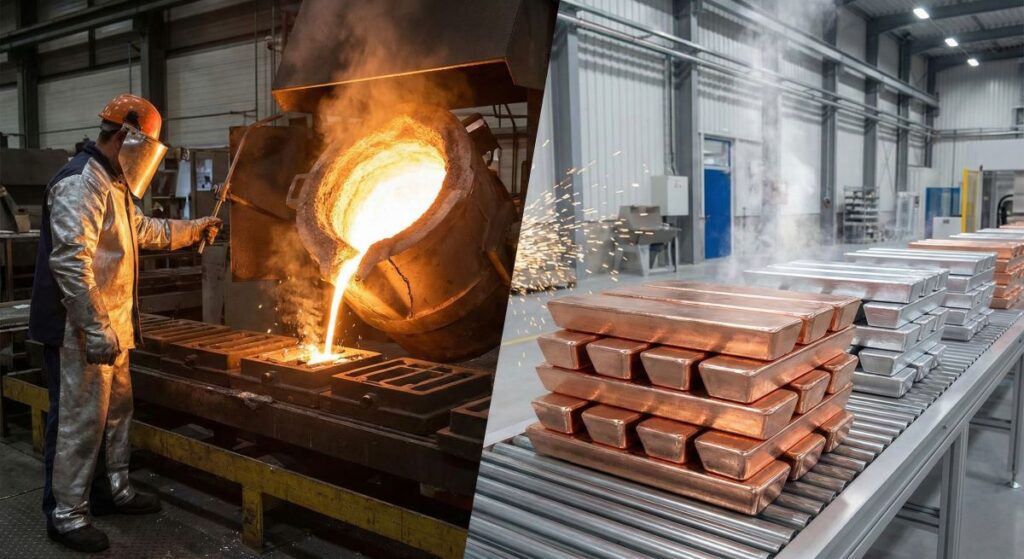
Once the concentrate is ready, it enters the realm of metallurgy. Here the chemical bonds are broken, to obtain a pure element. There are two main paths:
- Pyrometallurgy: Use of high temperatures in furnaces (melting), to remove impurities in the form of slag.
- Hydrometallurgy: Extraction of the metal by dissolution in acidic or alkaline solutions (leaching), followed by electrolysis.
The final step is refining. Purity is achieved by electrolysis 99,99% (for example with copper cathodes). These metal blocks, ingots or cathodes are the final product, which is traded on world exchanges and enters cable factories, components and alloys.
Sustainable management of mining waste and resources
Modern industry does not stop until the metal is obtained. The one in charge ore road also includes by-product management. Today, "waste" is increasingly seen as a resource. The loose rock is used to build roads or fill in worked spaces in mines (backfilling).
Process waters in modern enterprises are recycled in a closed cycle (over 90% reuse). The tailings storage facilities (tailings dumps) are subject to round-the-clock monitoring, to ensure the safety of the environment and the population.
Global context and economic importance of the sector
Globally, the sector is undergoing a massive transformation, dictated by the energy transition. The search for critical raw materials like honey, lithium, cobalt and rare earth elements is expected to grow exponentially to 2030 G. Europe, through the Critical Raw Materials Act (CRMA), aims to reduce its dependence on external supplies, which puts a focus on local mining and innovation.
The mining industry is the backbone of industrial independence. It creates highly qualified jobs and stimulates the development of high technologies in the regions, where it operates.
The future of the mineral industry and innovation
In the next ones 10 years ore path it will become even more digitized and green. Forecasts point to:
- Full automation: Mines without people underground, remote controlled.
- Electrification: Replacing diesel machines with battery or hydrogen systems.
- Circular economy: Combining primary mining with scrap recycling in the same metallurgical facilities.
The risks facing the sector are mainly related to public acceptance and longer terms for permitting regimes, but without these raw materials, the transition to a low-carbon economy is practically impossible.
For Geotopia.bg inspiration remains, that every metal element in our daily life is a materialized narrative, began in the bowels of the planet and ended as a triumph of human technological potential.