



Geological engineering is the scientific and applied discipline, which today underpins the global drive for technological progress and planetary sustainability. From the primitive tools of ancient civilizations to the implementation of artificial intelligence (AI) in drilling operations, this sphere is undergoing a radical metamorphosis. In the following series, we will look at how innovation is transforming the sector and why the profession of geological engineer is more critical than ever.
The roots of modern geological engineering: From Antiquity to Agricola
The journey of geological engineering it began thousands of years before its official recognition as a science. Already in 4000 G. BC. early societies demonstrated remarkable skill in identifying the copper and gold. Mesopotamian and Egyptian builders applied deep knowledge of rock properties to the construction of monuments and irrigation systems. The Great Pyramid of Giza is not just an architectural wonder, a testimony to the early mastery of the analysis of soil stability and the stability of rock massifs.
The industrial revolution in the 18th and 19th centuries dramatically increased the demand for resources, which pushes geological knowledge to new depths. A decisive historical moment occurred in 1556 G., when George Agricola published his landmark work:
"Man cannot exist without metals. If there were no metals, he would have led the most miserable and miserable life among the wild beasts.' — George Agricola, De Re Metallica.
This work lays the scientific foundations of the modern ones mining practices and formalized geology as a discipline, which combines resource extraction with engineering precision.
Technological breakthrough and the mining industry: The role of AI and digital doppelgangers
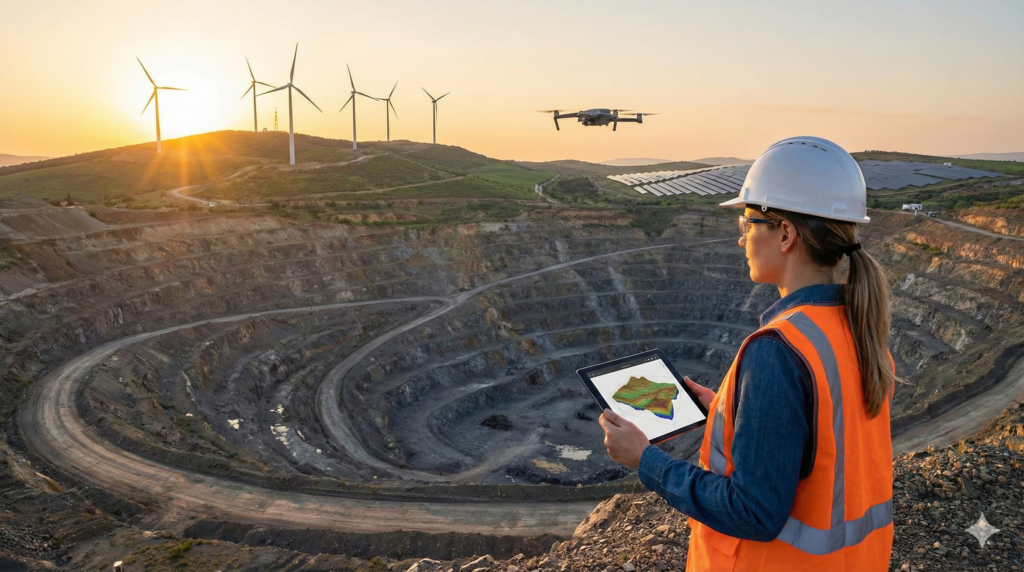
In the modern mining industry, innovation is not just a convenience, but a matter of survival and efficiency. Technologies for remote monitoring today allow terrain analysis, which until recently were unavailable. Through the use of satellite images and systems LiDAR (Light Detection and Ranging), specialists generate three-dimensional models of the terrain with centimeter accuracy, penetrating even through dense vegetation.
Key technology pillars:
- Artificial intelligence (AI): Machine learning algorithms analyze vast arrays of geological data, identifying subtle indicators of the presence of ore bodies, which the human eye would miss.
- Digital doubles (Digital Twins): Creating virtual copies of geological structures, where engineers test different operating scenarios, before starting physical work.
- Autonomous drilling systems: Robotic machines perform precision drilling in hazardous or contaminated environments, minimizing the risk to human life.
These tools convert the geological survey in an extremely precise operation, reducing operating costs and environmental footprint.
Global context and sustainable development: ESG standards in the study
Today sustainable development is a leading factor in the global economic agenda. The clean energy transition is impossible without critical minerals like lithium, cobalt and rare earth elements. In this context, geological engineering is transforming from an 'extraction' industry to a 'resource management' industry.
The application of ESG (Environmental, Social, and Governance) standards changes the way, according to which the mining sites are planned. Modern planning requires an assessment of the entire life cycle - from the first sod to the final one land reclamation. The global market no longer tolerates projects, which ignore the environmental impact.
On a global scale, we are observing interesting trends:
- Singapore and Helsinki: They develop large-scale underground master plans for urbanization, using the stability of the bedrock.
- Western Australia: A leader in autonomous mining operations, where driverless trucks are guided by complex geological models.
- Iceland: Uses geological expertise to develop geothermal energy and carbon capture systems (CCS).
The future of geology: Energy transition and extraterrestrial resources
Predictions for the next ones 5-10 years point, that geological engineering will play a decisive role in two main directions: climate resilience and space exploration.
Climate adaptation will require engineers to design more sustainable urban infrastructure, able to withstand extreme weather events. Coastal protection from sea level rise and groundwater management in areas, threatened by drought, will be priority #1.
In the even longer term, the gaze is directed to the Moon and Mars. Geological assessment of alien landscapes will support future colonization efforts. Engineers will have to adapt Earth techniques to vacuum conditions and low gravity, to extract resources such as water (ice) and metals from the regolith.
Socio-economic dimension
The profession is becoming increasingly interdisciplinary. The future geological engineer must master not only structural geology, but also computer science and ethics. Integrating indigenous knowledge and engaging local communities are now mandatory elements for the success of any large-scale project.
Frequently asked questions (FAQ)
What is the difference between a geologist and a geological engineer? While the geologist studies the history and composition of the Earth for a scientific purpose, the geological engineer applies this knowledge to solve practical engineering problems and design safe facilities.
What are the most sought-after specializations in the sector? Currently, the greatest hunger for personnel is in the fields of geothermal energy, hydrogeology (water security) and natural disaster management.
How AI is changing security at work? AI is not replacing engineers, and frees them from routine data processing. It allows professionals to focus on the interpretation of complex patterns and ethical decision making.
The evolution of geological engineering proves, that our future depends on our ability to understand and respect the processes of the planet, as we build the civilization of tomorrow.
Would you like to learn more about how innovations in geology are changing the investment landscape in Bulgaria?? Follow Geotopia.bg for the most up-to-date analyses.